Attribution & Measurement
Why Your ROAS Number Is Wrong: The Attribution Problem Every D2C Brand Faces
Your reported ROAS is almost certainly overstated. Here's why multi-platform attribution inflates the number and what to measure instead.
June 16, 2026
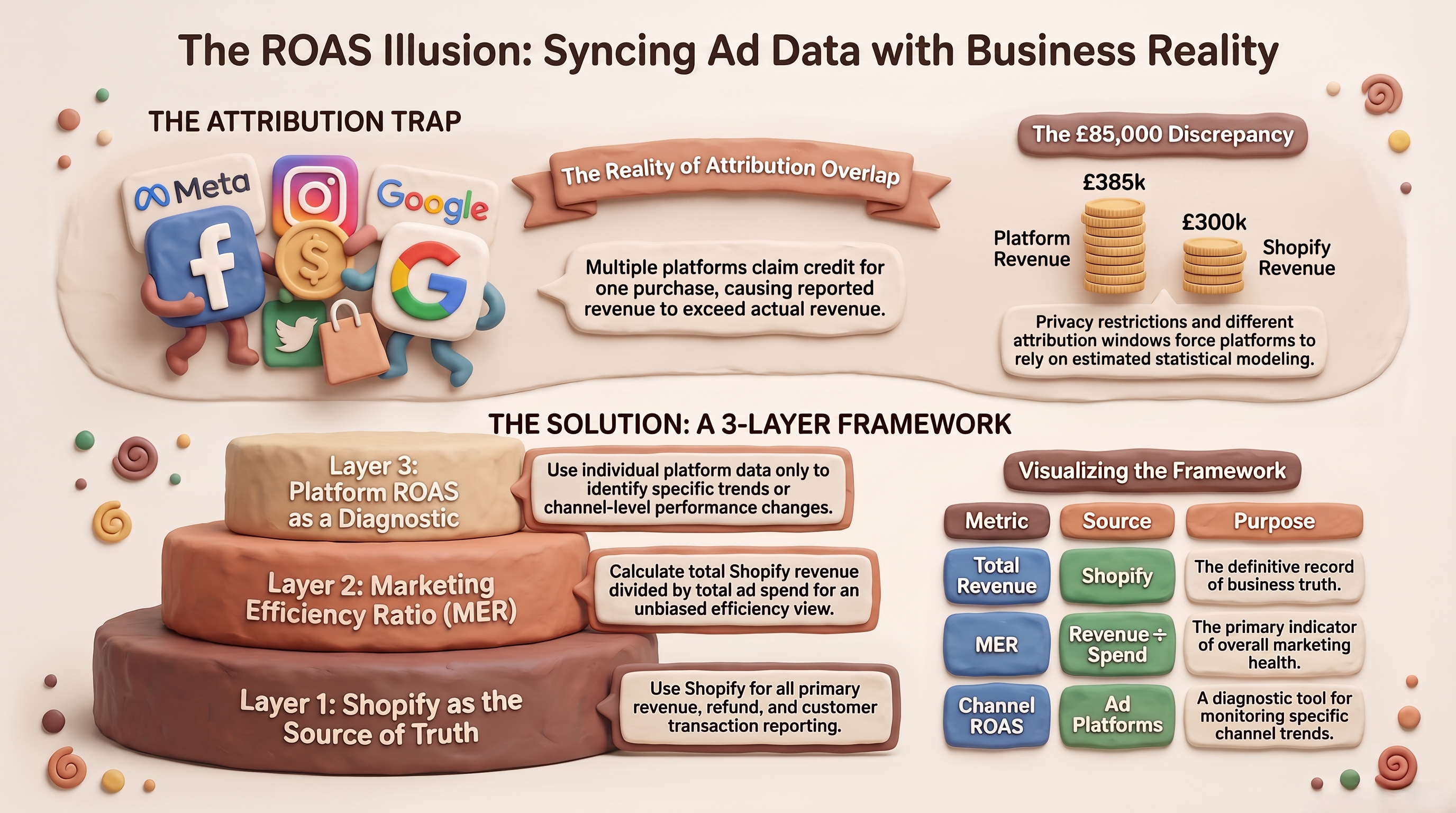
Why Platform ROAS Often Differs From Actual Business Performance
If your D2C brand advertises across multiple channels, the revenue reported by your ad platforms is unlikely to match the revenue reported by Shopify.
This discrepancy creates one of the most common measurement challenges in ecommerce. Marketing teams review strong ROAS figures inside advertising platforms, while finance and operations teams see a different picture when they look at total business performance.
Understanding why this happens is essential for making informed budget decisions and evaluating marketing efficiency accurately.
Understanding Attribution Overlap
Every advertising platform uses its own attribution model to determine which conversions it should receive credit for.
Meta, Google Ads, Klaviyo, and other platforms each track customer interactions independently and apply their own attribution windows.
Consider a customer journey like this:
- A customer sees a Meta ad on Tuesday.
- They click a Google Shopping ad on Thursday.
- They open a promotional email on Friday.
- They complete a purchase on Saturday.
From the perspective of each platform, that conversion may qualify for attribution.
As a result:
- Meta records the conversion.
- Google records the conversion.
- The email platform records the conversion.
The purchase occurred once, but multiple platforms claim credit for it.
This phenomenon is commonly known as attribution overlap.
Why Reported Revenue Exceeds Actual Revenue
Attribution overlap becomes more visible as brands expand across channels.
Consider a hypothetical ecommerce brand generating £300,000 in Shopify revenue during a month.
At month end:
- Meta Ads reports £210,000 in attributed revenue.
- Google Ads reports £175,000 in attributed revenue.
- Combined platform-attributed revenue equals £385,000.
- Actual Shopify revenue remains £300,000.
The additional £85,000 does not represent new revenue. It represents the same conversions being credited by multiple platforms.
It represents conversions that were counted by more than one platform.
When teams evaluate marketing performance using platform-reported revenue alone, efficiency can appear stronger than it actually is.
Why Attribution Differences Exist
Attribution overlap is a result of how advertising platforms measure performance.
Each platform evaluates customer journeys through its own dataset and attribution rules.
Several factors contribute to reporting differences:
- Different attribution windows
- View-through attribution
- Cross-device behavior
- Privacy restrictions
- Modelled conversions
Privacy changes have increased this complexity. Reduced third-party tracking and cross-device fragmentation mean platforms increasingly rely on statistical modelling to estimate conversions that cannot be observed directly.
As a result, reported attribution should be viewed as an estimate of contribution rather than a definitive record of revenue.
A More Reliable Measurement Framework
Many D2C brands benefit from separating revenue measurement from channel evaluation.
A practical framework consists of three layers.
1. Shopify as the Revenue Source of Record
Shopify should serve as the primary source for revenue reporting.
Orders, revenue, refunds, and customer transactions originate here. Every performance review should begin with the numbers generated by the ecommerce platform itself.
2. Marketing Efficiency Ratio (MER)
Marketing Efficiency Ratio provides a broader view of marketing performance.
The calculation is straightforward:
MER = Total Shopify Revenue ÷ Total Ad Spend
Because MER uses actual business revenue and total advertising spend, it avoids attribution disputes between individual platforms.
It answers a simple business question:
"How much revenue did the business generate for every pound spent on marketing?"
For many growing ecommerce brands, this metric provides a more stable indicator of overall marketing efficiency than platform ROAS alone.
3. Channel ROAS for Performance Monitoring
Platform ROAS still provides useful information.
The value lies in identifying trends and relative performance changes between channels.
For example:
- Meta ROAS declines 25%.
- Google ROAS remains stable.
- MER remains unchanged.
This suggests a platform-specific issue rather than a broader marketing efficiency problem.
Viewed in this context, channel ROAS becomes a diagnostic tool rather than the primary measure of business performance.
Reporting Infrastructure Matters
Measurement challenges are often reinforced by reporting architecture.
Many reporting systems pull metrics directly from advertising platforms and present them as primary business KPIs.
This creates a reporting environment where attributed revenue receives more attention than actual revenue.
A more reliable reporting structure places Shopify data at the centre of the reporting process and incorporates marketing metrics around it.
This approach aligns reporting with business outcomes rather than platform-specific attribution models.
Practical Steps for D2C Teams
Brands looking to improve measurement accuracy can start with a few straightforward actions:
- Calculate MER using Shopify revenue and total advertising spend.
- Use Shopify as the primary revenue source in weekly reporting.
- Review platform attribution windows and standardise them where possible.
- Track MER alongside channel-level ROAS rather than relying on platform ROAS alone.
- Compare platform-reported revenue against actual ecommerce revenue regularly.
These changes will not eliminate attribution differences, but they provide a more balanced view of marketing performance.
Final Thoughts
Attribution will never provide a perfectly complete view of customer behavior.
Modern ecommerce journeys span multiple devices, channels, and touchpoints, making precise attribution increasingly difficult.
For that reason, the most effective reporting systems combine actual business revenue, overall marketing efficiency metrics, and channel-level performance indicators.
When those layers work together, marketing decisions become less dependent on platform-reported attribution and more closely aligned with the reality of business performance.
About BizMetrics
BizMetrics helps D2C and ecommerce brands build reporting systems that connect Shopify, advertising platforms, and operational data into a single source of truth.
For more insights on ecommerce analytics, attribution, and reporting infrastructure, follow BizMetrics on LinkedIn.
Need help with your analytics?
Let's structure your data into something you can actually use.
Start a conversation